Your Server. Your Brand. Every Client in One Platform.
Install CMSPost on your agency’s compatible hosting environment, brand it as your own, and manage client onboarding, SEO content, website publishing, social media, communications, Google reviews, and reputation from one lightweight, modular, protected platform.
Home
•
Insights
•
What Is a Headless CMS? Architecture, Benefits, Costs, and Agency Use Cases
Headless CMS Platform
What Is a Headless CMS? Architecture, Benefits, Costs, and Agency Use Cases
By CMS POST INC
CMS Architecture
What Is a Headless CMS? Architecture, Benefits, Costs, and Agency Use Cases
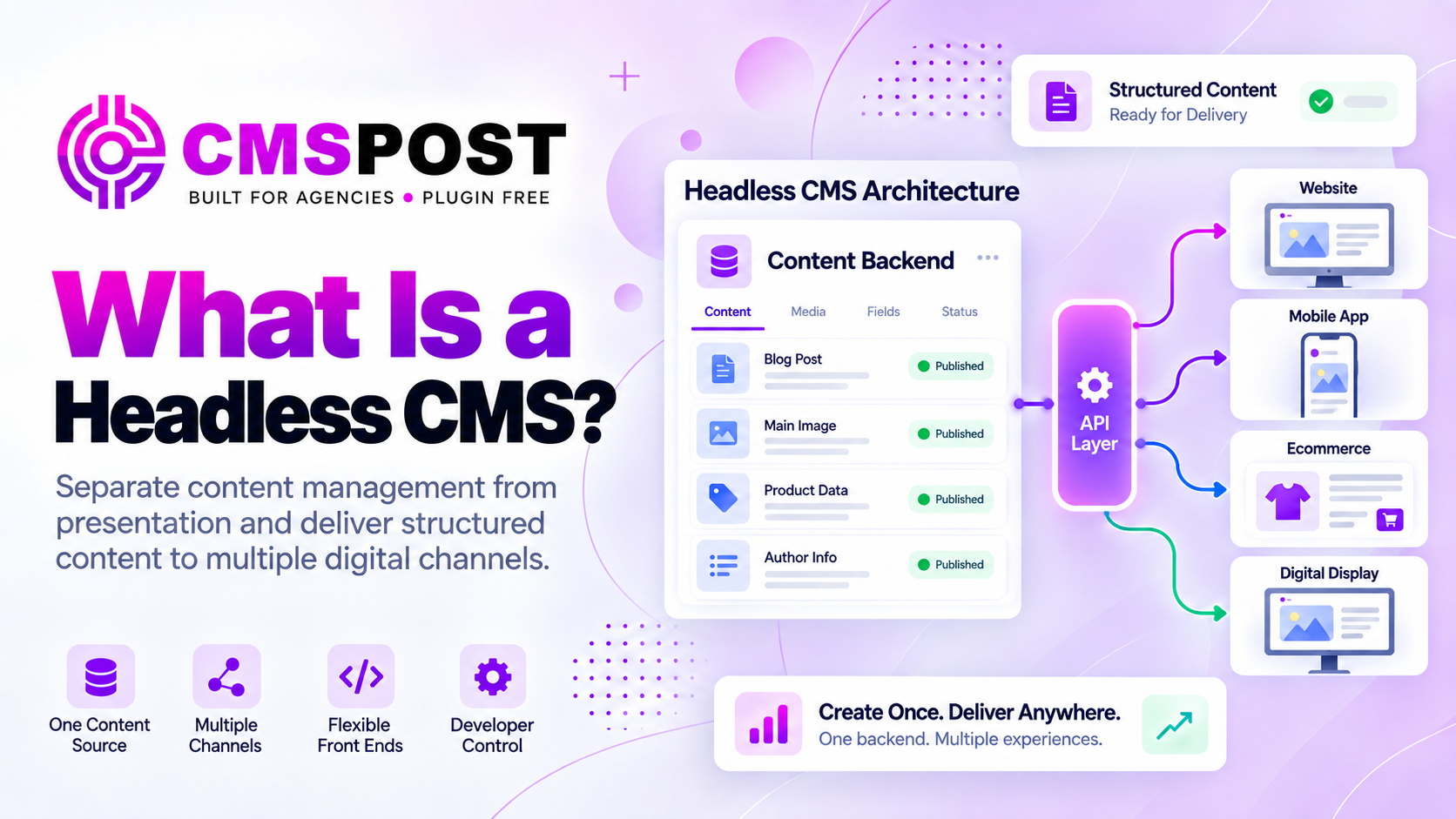
A headless CMS separates the place where content is managed from the code that presents it to an audience. Instead of assuming every article belongs inside one built-in website theme, it makes structured content available through an application programming interface, or API. Developers can then deliver that content to a website, mobile application, digital display, client portal, voice interface, or another channel.
What “Headless” Actually Means
In CMS terminology, the “head” is the presentation layer: templates, layouts, navigation, and frontend code visitors experience. A traditional CMS usually combines that presentation layer with an administrator, database, media library, and publishing system. A headless CMS keeps the content-management body but removes the assumption that one built-in frontend must be attached.
Editors still need fields, drafts, workflows, permissions, media, and publishing controls. The difference appears after publication. Rather than asking the CMS theme to generate the final page, a separately developed frontend requests content through REST, GraphQL, or another API and decides how to render it.
Traditional, Decoupled, and Headless CMS Models
Model
Content and presentation
Typical advantage
Typical tradeoff
Traditional CMS
Managed and rendered by one application
Faster setup and familiar previews
Frontend choices may be constrained by the CMS
Decoupled CMS
Built-in presentation plus APIs or separated delivery options
Flexible migration path
Two delivery models can add complexity
Headless CMS
Content backend separated from independently built frontends
Channel flexibility and developer control
Frontend engineering becomes mandatory
These labels are not always applied consistently. Some vendors call any CMS with an API headless, while others reserve the term for platforms without a native presentation layer. Agencies should evaluate what the product actually does rather than relying only on the label.
How Headless Publishing Works
An editor creates structured entries such as articles, authors, products, locations, services, or frequently asked questions. The CMS stores fields and relationships. A frontend application authenticates with the content service, requests published records, transforms the response, and renders the experience.
The frontend might generate static pages during a build, render pages on the server when requested, regenerate selected pages after content changes, or fetch data in the browser. Webhooks can tell the build system when new content is ready. A content delivery network may cache API responses and finished pages. Preview environments must show editors how unpublished content will appear before it reaches production.
This architecture is a system, not merely an API checkbox. Content modeling, frontend rendering, deployment automation, authentication, caching, previews, search, image processing, redirects, analytics, and monitoring all need deliberate ownership.
Why Organizations Choose a Headless CMS
Multiple channels: One structured content source can serve websites, applications, displays, and other experiences. This is valuable when the same product, location, or editorial information must appear in several places.
Frontend freedom: Developers can select frameworks and hosting strategies without rebuilding the editorial database. Design systems can evolve independently from content-management workflows.
Performance options: Static generation, edge caching, server rendering, and optimized asset delivery can produce fast experiences when implemented well.
Separation of concerns: Content editors work in the CMS while frontend developers own presentation. A breach or outage in one layer may be easier to contain when services and permissions are properly segmented.
Reusable structured content: Teams can model information as reusable components rather than copying page-shaped documents. Updating one structured record can update several experiences.
The Hidden Costs of Headless Architecture
Headless software is sometimes marketed as simpler because the CMS no longer renders the website. In reality, that responsibility moves elsewhere. The organization may need frontend developers, framework upgrades, hosting, build pipelines, previews, API monitoring, search services, image transformation, analytics, personalization, localization, caching, and incident response.
Vendor pricing may also depend on users, content records, locales, API requests, bandwidth, environments, or projects. A traffic increase can affect both delivery infrastructure and CMS usage. Custom frontend code creates its own long-term maintenance obligation even when the content backend is managed by a vendor.
For an agency, these costs multiply when every client has a different framework or deployment provider. Headless can standardize content models, but it can also create a portfolio of custom applications requiring specialized developers. The total-cost calculation must include engineering time, not just the CMS subscription.
Headless CMS SEO Requires Engineering
A headless CMS is not automatically SEO-friendly or SEO-hostile. Search performance depends on the frontend implementation. Google can process JavaScript, but its documentation still emphasizes accessible rendering and troubleshooting JavaScript-related indexing problems. Agencies should not assume that content returned by an API will become a discoverable search page by itself.
The frontend must produce unique titles, descriptions, canonical URLs, headings, crawlable links, image attributes, robots directives, sitemaps, redirects, social metadata, and structured data. It must handle deleted or moved content correctly. Server-side rendering, static generation, or reliable prerendering can make the initial HTML easier for crawlers and users to process.
Editorial previews also matter. Writers need to see whether headings, metadata, links, schema, and calls to action appear correctly before publication. An elegant API with a weak preview and governance process can create expensive SEO mistakes at scale.
Security Does Not Disappear When the CMS Has No Frontend
Separating the content backend from the public frontend may reduce direct exposure of the editorial application, but APIs create their own security responsibilities. Authentication, authorization, rate limiting, token storage, field-level permissions, input validation, logging, dependency updates, and environment separation require attention.
Public content APIs should expose only intended published data. Preview tokens and management credentials must never be embedded in browser code. The OWASP API Security project highlights risks such as broken authorization, unrestricted resource consumption, security misconfiguration, and improper inventory management—issues directly relevant to headless systems.
A secure architecture also accounts for frontend dependencies, deployment credentials, webhooks, build services, CDN settings, third-party scripts, and developer access. Headless changes the attack surface; it does not eliminate it.
When a Headless CMS Makes Sense for an Agency
Headless is a strong candidate when a client genuinely needs several digital channels, a custom application experience, a reusable product or location model, international content, unusually high frontend control, or a development team capable of owning the complete delivery system.
It may be excessive for a conventional service-business website whose primary needs are articles, service pages, location pages, forms, metadata, and reliable publishing. In that situation, a custom frontend can add cost without creating proportional business value.
Before recommending headless, agencies should ask who will maintain the frontend in three years, how editors will preview changes, how redirects and schema will be governed, what happens if the CMS vendor changes pricing, and whether content can be exported in a useful form.
Where CMSPost Fits
CMSPost is not positioned as a pure API-only headless CMS. It is a lightweight, client-isolated agency platform with several delivery approaches. Rendered output, embedded delivery, Mirror Mode, static output, and its Theme Engine give agencies choices about how managed content reaches compatible client websites.
This can provide some of the practical flexibility agencies seek from headless architecture without requiring every client to fund a custom JavaScript frontend. CMSPost can preserve existing sites, centralize content operations, attach metadata and schema to managed content, and keep each client's users and activity separate.
Agencies evaluating vendor-hosted systems may also find the related CMSPost versus HubSpot CMS comparison useful. The next architectural question is whether a focused lightweight CMS can deliver the required flexibility with less engineering overhead.
Frequently Asked Questions
What is a headless CMS in simple terms?
A headless CMS manages content without controlling one fixed website presentation layer. It sends structured content through an API to websites, applications, kiosks, or other digital experiences built separately.
Is a headless CMS automatically faster?
No. Headless architecture creates opportunities for fast static or server-rendered delivery, but performance still depends on frontend code, API design, caching, hosting, images, scripts, and third-party services.
Is a headless CMS better for SEO?
Not automatically. A well-built frontend can provide excellent SEO, but the development team must correctly implement crawlable rendering, metadata, canonical URLs, structured data, sitemaps, redirects, internal links, and performance.
Does a headless CMS cost more?
It can. Total cost may include the CMS, frontend development, hosting, preview systems, deployment pipelines, API usage, search, image delivery, monitoring, security, and ongoing engineering.
Is CMSPost a pure headless CMS?
CMSPost is not positioned as a pure API-only headless CMS. It offers multiple content-delivery approaches that can provide headless-like flexibility while supporting agencies that do not want to build every frontend from scratch.
Tags:HeadlessHeadless CMSWhat is Headless CMSPlugin UpdatesCMS PlatformHeadless CMS SEO
C
cmspost.com Editorial Team
Helpful perspectives, practical guidance, and resources published for our readers.