We Built CMSPost: Introducing a New Era of AI-Powered SEO and Agency Automation
How 30 years of SEO experience, one year of development, and a new generation of AI technology came together to create a white-label operating system for digital marketing agencies.
By Blake Schiller | Founder, CMSPost Inc. | November 2026
For nearly 30 years, I've worked in SEO and digital marketing. I've watched the industry evolve from basic website optimization and keyword placement into an increasingly complex ecosystem of technical SEO, content marketing, local search, social media, structured data, and now artificial intelligence.
Throughout those changes, one problem has remained remarkably consistent.
Agencies are expected to deliver more results, manage more tools, and serve more clients—often without a corresponding increase in time, resources, or profitability.
An agency might use one platform for website management, another for keyword research, another for content production, another for social media, and several more for email, reporting, customer communication, and lead generation.
I've spent years working inside that environment.
Eventually, I began asking a different question:
What if we could bring these essential agency operations together in one system, powered by AI, without forcing agencies to surrender control of their hosting, branding, or existing client websites?
That question became CMSPost.
Today, after an intensive year of development, I'm excited to share where the platform stands, what we've built, and where we're taking it next.
CMSPost: The AI-Powered, White-Label SEO Operating System for Digital Marketing Agencies
CMSPost is designed to help agencies discover opportunities, research markets, create content, optimize websites, publish across digital channels, and manage multiple client workspaces from one connected platform.
Unlike conventional vendor-hosted SaaS products, CMSPost offers a downloadable, licensed agency installation that can run on compatible hosting controlled by the agency.
Our philosophy is straightforward:
Your Hosting. Your Brand. Your Clients. Your AI.
We wanted agencies to have greater control over the systems they rely on to serve their customers.
That includes the ability to bring their own AI API credentials, organize clients into separate workspaces, and deliver new content to existing websites without requiring a complete migration to another website builder.
But the most important part of CMSPost isn't simply the technology.
It's how the different capabilities work together.
From Individual AI Tools to a Connected AI Workforce
Artificial intelligence is changing how agencies operate.
The opportunity isn't simply to generate articles faster or create social media captions with a prompt.
It's to connect research, strategy, execution, optimization, and publishing into workflows that reduce repetitive work while keeping experienced professionals responsible for important decisions.
CMSPost was developed around that philosophy.
Instead of asking an agency to move information manually between disconnected tools, our AI agents and supporting engines are designed to work within a shared client context.
1. Prospect Intelligence: Discovering New Business Opportunities
One of the most challenging parts of growing an agency is consistently finding qualified prospective customers.
Our Prospect Intelligence system helps agencies research businesses, identify potential digital marketing opportunities, and organize prospects for outreach.
The research workflow can prepare:
Business research and executive summaries.
Website and digital-presence observations.
SEO and content opportunities.
Opportunity prioritization and confidence indicators.
Suggested conversation starters and sales talking points.
AI-assisted outreach drafts.
The objective is to help agencies have better-informed conversations with potential customers.
CMSPost also includes social outreach assistance for organizing contacts and preparing messages. Supported workflows keep the actual outreach under user control rather than assuming that every social network permits automated sending.
For agencies, this connects the earliest stage of business development to the services they can eventually deliver.
2. Entity Intelligence: Understanding the Client Before Creating Content
Effective AI content starts with accurate business information.
Our Entity Intelligence workflow helps organize information about a client's business, services, locations, and relevant context.
This matters because content shouldn't be generated in isolation.
An article for a moving company in California should reflect a different business, customer need, and geographic market than an article for a professional services firm in New York.
By creating structured client profiles, CMSPost provides a foundation for more relevant research and content planning.
The agency remains responsible for verifying business facts before publication.
3. Keyword Intelligence: Turning Research Into Strategy
Keyword research has always been central to SEO, but collecting keywords is not the same as developing an effective content strategy.
CMSPost's Keyword Intelligence capabilities help agencies organize and evaluate search opportunities.
Those insights can feed into content planning and SEO Autopilot workflows, allowing teams to connect research with the actual work of creating and improving website content.
Our goal is to reduce the distance between discovering an opportunity and taking meaningful action on it.
4. SEO Autopilot: Building a More Consistent Publishing Strategy
SEO requires consistency.
Agencies frequently know what should be published but struggle to maintain schedules across multiple clients.
CMSPost's SEO Autopilot workflows support structured 30-, 60-, and 90-day planning, configurable publishing volume, content-type selection, and opportunity-based prioritization.
Teams can use manual, approval-oriented, or supported automated workflows depending on their configuration.
Rather than treating every article as a separate project, agencies can organize a continuing content strategy around each client's objectives.
AI can assist with planning and production, but editorial oversight, technical quality, and ongoing measurement remain essential.
The New AI Content Engine: From One Prompt to an Editorial Workflow
One of our most exciting developments is the evolution of the CMSPost AI Content Engine.
We've been building an editorial workflow designed to move beyond simply asking an AI model to write an article.
The process begins with a natural-language request.
An agency can describe the content it needs, the target audience, the business objective, and the desired outcome.
CMSPost then guides the request through a structured sequence:
Prompt → Editorial Strategy → Research and Verification → Generate and Review
The system is designed to support keyword direction, article structure, calls to action, metadata, schema drafts, and supporting content.
Crucially, the workflow is built around human review.
We don't believe that generating more content automatically produces better SEO.
Content still needs to be accurate, useful, aligned with search intent, and appropriate for the business publishing it.
AI accelerates production. Agency expertise determines quality.
That's the distinction we've tried to preserve throughout CMSPost.
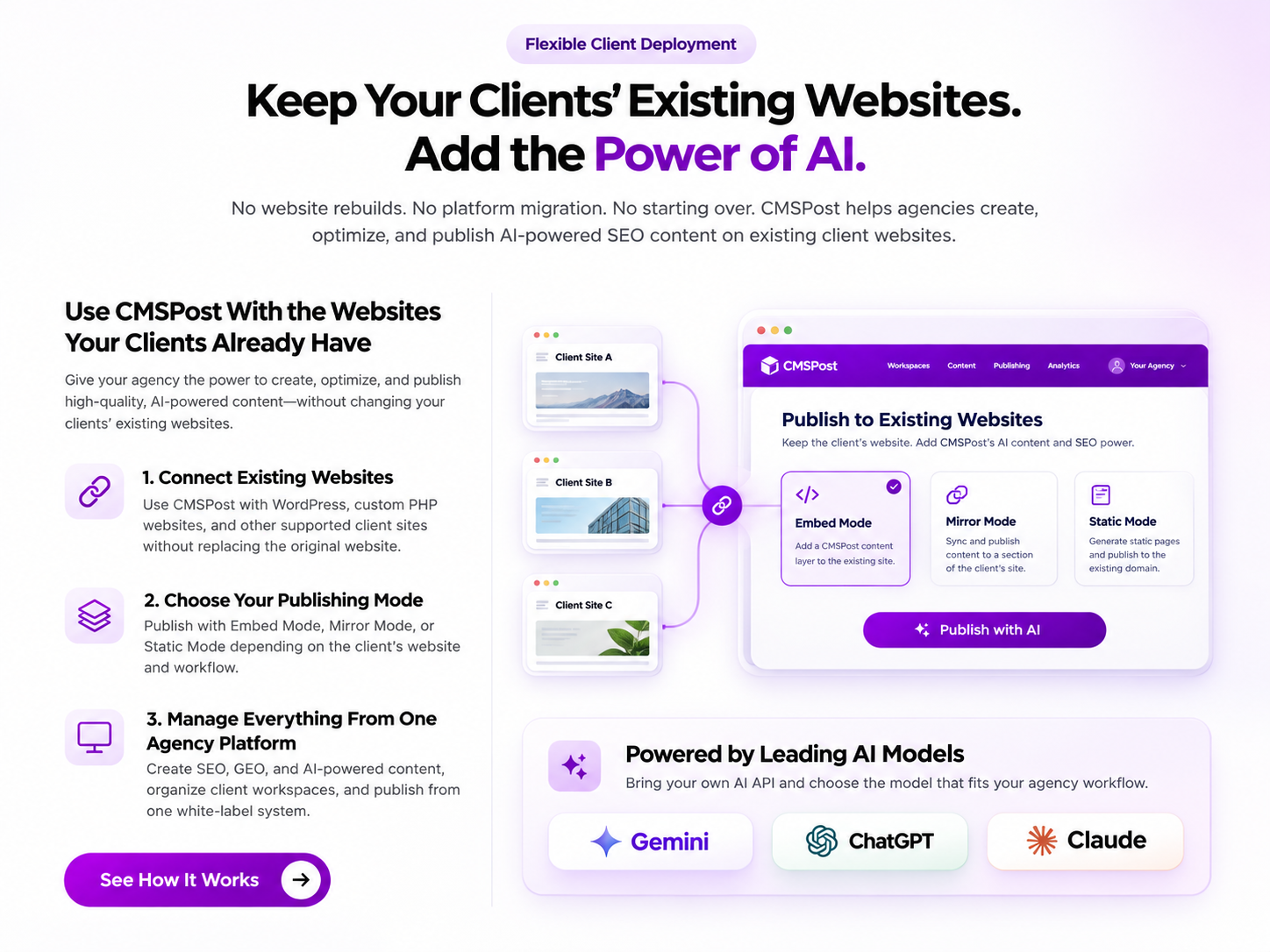
Three Major AI Ecosystems: OpenAI, Google Gemini, and Anthropic Claude
Another important milestone in our latest development cycle has been expanding the CMSPost AI architecture beyond a single provider.
CMSPost's multi-provider direction brings together support for three leading AI ecosystems:
OpenAI: Access to supported OpenAI models for agency content and research workflows.
Google Gemini: Additional AI model options through Google's Gemini ecosystem.
Anthropic Claude: Claude model integration for supported AI-assisted workflows.
Our approach is based on bringing your own API credentials.
Instead of relying exclusively on AI usage bundled into a central subscription, agencies can configure supported providers and manage their own model usage and associated costs.
This creates flexibility in model selection, budgeting, and workflow design.
Feature availability may vary by provider, model, and CMSPost release, and agencies should verify supported configurations in their installation.
We're building CMSPost to make AI more adaptable to agency needs—not to make agencies dependent on one model vendor.
GEO Automation: Creating Location-Specific Content at Scale
Local SEO is another area where agencies face substantial operational challenges.
A company serving dozens or hundreds of cities needs content that accurately reflects those locations, services, and customer requirements.
Simply changing a city name in an otherwise identical article is not a strong long-term strategy.
CMSPost's GEO and service-area publishing workflows help agencies organize campaigns around geographic markets and create customized local content.
The GEO Wizard supports campaign setup, city selection, AI-assisted content drafting, location tokens, city-specific overrides, previewing, and publication workflows.
Agencies can work with structured information such as:
City, state, county, and service location.
Primary keywords and targeted services.
Business information and calls to action.
Location-specific FAQs and content sections.
Metadata and supported structured data.
Images, testimonials, offers, and other modular content elements.
Our approach combines reusable workflows with the ability to make individual location pages meaningfully different.
That matters because local relevance depends on accuracy, usefulness, service availability, and the actual needs of the people searching.
The system helps agencies manage the production process. It does not guarantee search rankings or inclusion in AI-generated answers.
Internal Linking, Content Refresh, and Technical SEO
Publishing new content is only part of an effective SEO program.
Existing content needs attention, too.
We've developed additional CMSPost capabilities that help agencies evaluate and maintain their content libraries.
Internal Linking Agent: Helps identify relevant linking opportunities, suggest anchor text, preview proposed changes, and apply approved links with safeguards such as backups and rollback support.
Content Refresh Agent: Evaluates existing content using signals such as freshness, metadata, schema, content depth, and other review criteria, then prioritizes pages that may deserve attention.
SEO Metadata and Structured Data: Supports search-focused page titles, descriptions, headings, and JSON-LD structured data appropriate to the content.
Search Discovery Workflows: Help organize published pages, website URLs, and sitemap-aware publishing.
These capabilities are designed to support the ongoing work of SEO—not merely produce a steady stream of new articles.
For agencies managing large content libraries, that distinction is important.
Keep Your Clients' Existing Websites. Upgrade Their SEO Workflow.
This may be one of the most important architectural decisions we made when developing CMSPost.
Agencies do not need to rebuild all their clients' websites to begin using the platform.
Many agencies manage websites across WordPress, custom PHP environments, and multiple hosting providers.
Requiring every customer to migrate to a completely new website platform would introduce significant cost, complexity, and risk.
We wanted a different approach.
CMSPost offers three main content deployment methods.
Embed Mode
Embed Mode allows supported CMSPost content to be displayed within an existing website using a lightweight integration.
The client keeps the original website while the agency manages supported content through CMSPost.
Mirror Mode
Mirror Mode provides a way to integrate CMSPost-managed content with compatible existing website layouts and structures.
This helps agencies extend content publishing without necessarily replacing a client's full website.
Static Pull Mode
Static Pull generates deployable website files that can be transferred into compatible hosting environments.
This offers an additional publishing option when a continuously connected CMS integration isn't the preferred approach.
Each method has different technical requirements, but they share a common objective:
Preserve the client's existing investment while modernizing the agency's content operations.
Smart Import: An Optional Path for Existing Content
We also developed the CMSPost Smart Import Engine.
This capability can scan eligible, publicly accessible website pages and collect information such as URLs, titles, metadata, headings, and content for review.
Agencies can then choose which material to bring into the appropriate CMSPost client workspace.
Smart Import is especially useful when an agency wants to organize or improve an existing content library.
But it's important to emphasize that importing content is optional.
Agencies can use CMSPost's publishing capabilities alongside existing websites without necessarily migrating all of their previous content.
Social Media Publishing and Scheduling
Today's agencies often manage a client's website content and social media presence simultaneously.
CMSPost includes social media publishing and scheduling workflows designed to help coordinate that work.
The platform has developed integrations for supported networks including Facebook Pages, Instagram Business, X, YouTube, and LinkedIn, with additional provider integrations and functionality in varying stages of availability and review.
Agencies can organize social content, connect supported provider accounts, and manage scheduled publishing workflows.
Our broader vision is to make it easier to take useful content created for a client and adapt it for additional marketing channels.
For example, a researched article may provide material for social posts, educational updates, or other content formats.
The objective is consistency and efficiency—not indiscriminate automated posting.
Email Marketing, Communications, and Reputation Workflows
Beyond content and social media, CMSPost includes capabilities that support the wider agency-client relationship.
Our Mailchimp integration work supports client-oriented marketing contacts, audiences, templates, campaigns, and associated workflows.
The platform also includes communication features for managing client-related messages and notifications, along with forms and lead-capture capabilities.
For reputation management, we've developed workflows around Google Business Profile connectivity and review-related functionality, subject to the account permissions and API requirements involved.
Not every capability has the same rollout status, and some integrations depend on third-party services.
However, our direction remains consistent: connect essential marketing operations to the same agency-managed client workspace.
An Operating System Agencies Can Host Under Their Own Brand
One of the defining differences between CMSPost and many conventional agency SaaS platforms is our installation model.
CMSPost is designed to be installed on compatible agency-controlled hosting.
Agencies can operate their own licensed system, organize multiple client workspaces, control their branding, and configure supported integrations.
That doesn't mean self-hosting removes operational responsibility.
Hosting, security, updates, backups, API credentials, and maintenance still matter. CMSPost includes update and licensing workflows intended to support distribution and administration.
But it does mean agencies have a different infrastructure option from relying entirely on a vendor-hosted dashboard.
For established agencies seeking greater flexibility, that choice may be especially valuable.
Built for Agency Growth, Not Just Content Production
We also recognize that agencies need business infrastructure alongside technical tools.
CMSPost includes package-based licensing, client-domain limits, white-label workspaces, agency roles, and partner commission workflows.
We've been building onboarding and distribution processes so new agencies can obtain a licensed package and establish their own installation.
The broader sales CRM remains a future development area. Rather than delaying the platform's introduction to the market until every possible feature is complete, we're prioritizing the capabilities agencies can use today.
That is an important decision for us.
Software is never permanently finished. There will always be improvements to make.
But at some point, the most valuable next step is getting the platform into the hands of real customers.
Why I Built CMSPost
After three decades in digital marketing, I've learned that technology alone doesn't make a successful agency.
Experience matters.
Strategy matters.
Client relationships matter.
And above all, delivering real business value matters.
Artificial intelligence can reduce the time required to research topics, develop content, organize opportunities, and perform repetitive tasks.
But it doesn't eliminate the need for judgment, ethical marketing practices, accurate information, or accountability.
I built CMSPost to give agencies more time to focus on those responsibilities.
What would once have required a much larger traditional development effort became possible for us within an intensive year of AI-assisted development.
That's been one of the most remarkable parts of this journey.
AI helped accelerate the creation of the platform. Now we're applying those same principles to help agencies operate more efficiently.
Where CMSPost Stands in November 2026
We've reached a major development milestone.
Our November release work has brought together improvements in independent agency deployment, AI provider integration, content workflows, and public product positioning.
We've also validated a packaged agency distribution that includes the updated deployment components and public Embed API assets.
That is meaningful technical progress, although ongoing installation verification, compatibility testing, and improvements remain part of responsible product development.
The next phase is focused on practical adoption: helping agencies experience the software, configure their own installations, onboard clients, and evaluate how CMSPost fits their services.
We're shifting our focus from continually adding features toward demonstrating real business value.
And personally, that's an exciting milestone.
What's Next: Helping Agencies Put AI to Work
Our vision for CMSPost is not to replace SEO professionals or turn every agency into an identical automated marketing business.
It's to give experienced agencies better infrastructure.
Infrastructure that helps them research opportunities, build useful content, scale local search workflows, maintain websites, publish across supported channels, and serve more customers without automatically increasing overhead.
We're continuing to improve the platform based on implementation experience and agency feedback.
For now, our priority is simple:
Get CMSPost into the hands of agencies that want to take control of their AI-powered SEO operations.
Ready to Explore CMSPost?
If you operate a digital marketing or SEO agency and want greater control over your technology, we invite you to explore CMSPost.
See how the platform brings together prospecting, AI agents, SEO, GEO, social publishing, and existing website integration through one white-label agency workspace.
Your Hosting. Your Brand. Your Clients. Your AI.
Explore the available Free agency package or schedule a personal demonstration.
Explore CMSPost
Book a Live Demo
Blake Schiller is the founder of CMSPost Inc., bringing approximately 30 years of experience in SEO, digital marketing, website development, and agency operations to the development of AI-powered marketing technology.