Your Server. Your Brand. Every Client in One Platform.
Install CMSPost on your agency’s compatible hosting environment, brand it as your own, and manage client onboarding, SEO content, website publishing, social media, communications, Google reviews, and reputation from one lightweight, modular, protected platform.
Home
•
Insights
•
What Is a Lightweight CMS? A Faster, Simpler Approach to Content Management
CMS Platform
What Is a Lightweight CMS? A Faster, Simpler Approach to Content Management
By CMS POST INC
CMS Architecture
What Is a Lightweight CMS? A Faster, Simpler Approach to Content Management
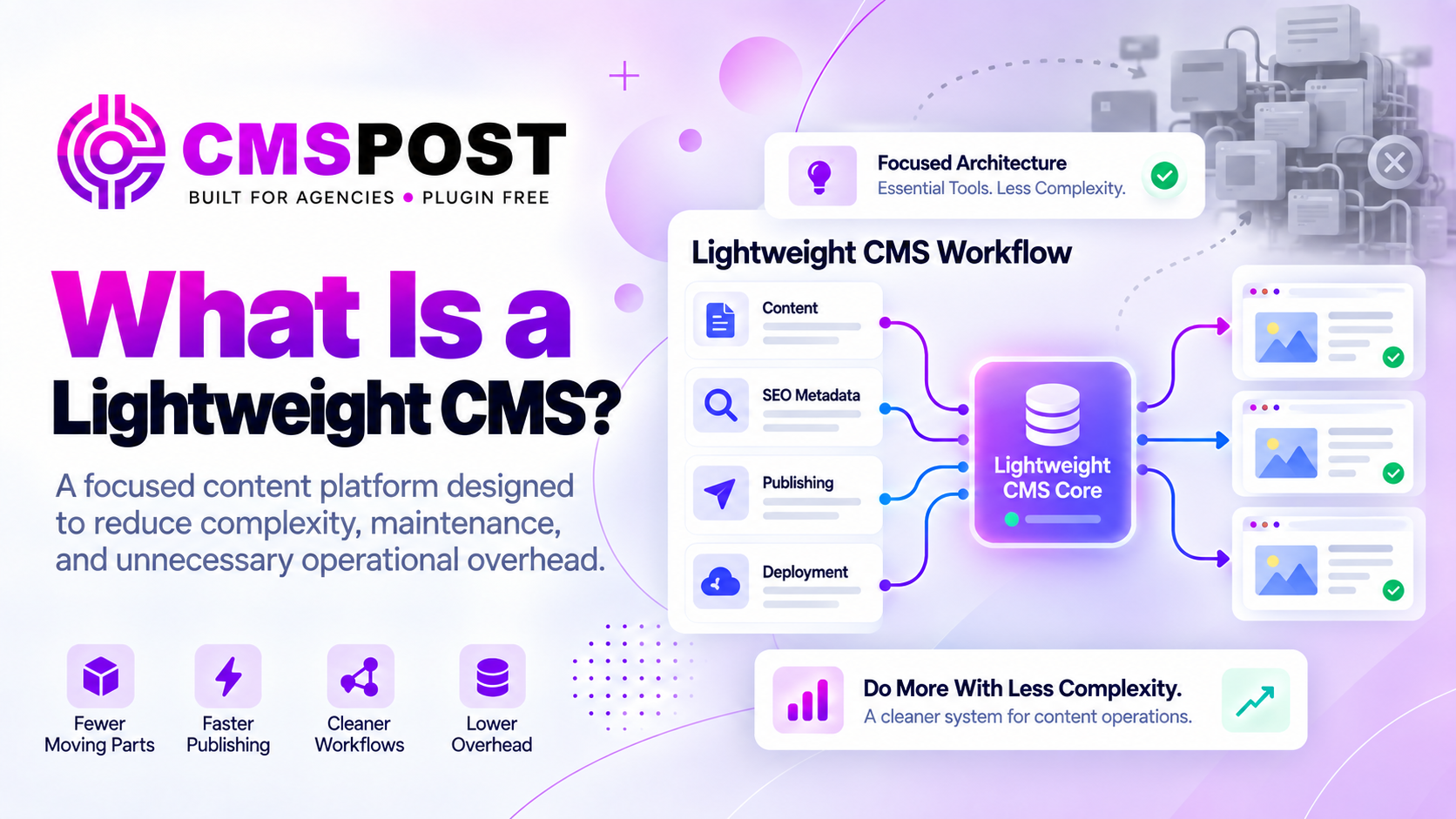
A lightweight CMS is designed to accomplish its intended publishing work without carrying unnecessary software, dependencies, processing, or administrative overhead. The term sounds simple, but it is frequently reduced to one number—installation size—or used as a vague synonym for speed. A CMS can occupy little disk space and still deliver slow pages. Another can have a substantial backend while producing highly optimized public experiences. Agencies need a more useful definition.
Server processing, database queries, memory use, background jobs, and API calls
Affects response time and hosting capacity
Browser payload
HTML, CSS, JavaScript, fonts, images, and third-party requests
Affects loading, responsiveness, and user experience
Dependency surface
Plugins, packages, integrations, vendors, and update chains
Affects security, compatibility, and maintenance
Operating overhead
Training, dashboards, configuration, publishing steps, and client administration
Affects agency labor and scalability
A genuinely lightweight CMS performs well across several of these dimensions. It does not merely win a smallest-download contest.
Small Installation Does Not Equal Fast Website
Installation footprint describes storage on the server. Page weight describes what a browser downloads. Runtime workload describes the server and database work required to generate a response. These measurements influence one another, but they are not interchangeable.
A tiny CMS can load an oversized hero image, multiple font families, advertising scripts, analytics tags, chat tools, and unoptimized JavaScript. A larger application can use caching and carefully designed templates to deliver lean pages. Marketing claims should identify which form of “lightweight” they mean.
Google’s Core Web Vitals focus on real-world loading performance, responsiveness, and visual stability through Largest Contentful Paint, Interaction to Next Paint, and Cumulative Layout Shift. Those outcomes are measured at the page experience—not by counting CMS files.
How Platforms Become Heavy
A CMS often begins with a manageable core and grows through additions. A page builder controls layout. Separate tools add forms, schema, SEO controls, redirects, caching, image optimization, security, backups, ecommerce, social sharing, analytics, and email connections. Each component may be defensible by itself, while the combined system becomes difficult to understand.
Weight also appears in vendor-hosted platforms. An all-in-one SaaS product may avoid local plugins but include CRM, sales, service, automation, AI credits, communications, marketplace apps, and complex permissions. Customers do not manage server files, yet teams still carry configuration and subscription overhead.
Headless architecture can move weight into frontend frameworks, packages, APIs, build systems, previews, hosting providers, and deployment pipelines. As explained in our guide to headless CMS architecture, separation creates flexibility but not automatic simplicity.
Why Dependencies Matter
Every dependency creates a relationship the owner must govern. It may have a maintainer, version policy, license, support team, security history, compatibility range, data-processing role, and renewal date. Dependencies can save enormous development time, but they are not operationally free.
When one package changes, connected components may also require changes. When a vendor discontinues a product, the agency must replace it. When an extension becomes vulnerable, every client installation using it may require immediate attention. A lightweight approach limits dependencies to those that create clear value and standardizes them across the portfolio.
This principle does not require rejecting all integrations. Social networks, email delivery providers, payment processors, and analytics services naturally involve external systems. The goal is to avoid unnecessary duplication and understand exactly which provider owns each critical function.
Security Benefits and Limits
A smaller application and dependency surface can give administrators fewer components to inventory, patch, and monitor. Fewer executable extensions can mean fewer opportunities for abandoned code, conflicting permissions, or delayed security updates. Simpler architecture can also make unusual changes easier to detect.
Lightweight does not mean invulnerable. A compact system can still be compromised through weak passwords, exposed administration pages, insecure hosting, outdated code, misconfigured permissions, stolen API keys, vulnerable custom code, or inadequate backups. Security requires layers: authentication, least-privilege access, updates, monitoring, encryption, network protection, logging, and tested recovery.
The useful claim is therefore modest but meaningful: reducing unnecessary components can reduce the surface an agency must govern. It does not eliminate the obligation to govern it well.
Why Lightweight Architecture Matters More at Agency Scale
A single business may tolerate a complicated website because one administrator understands its history. Agencies inherit dozens of histories. Every client may use a different host, theme, builder, extension stack, login policy, backup tool, and publishing procedure.
Small inefficiencies multiply. Ten minutes spent checking updates across fifty websites becomes more than eight hours. Fifteen extensions across fifty sites create 750 installations to inventory. Separate writing, SEO, social, email, and form systems create repeated context switching before any strategic work begins.
A lightweight CMS for agencies should reduce portfolio variation. It should allow shared operating standards while protecting client isolation. Content, users, domains, connections, and activity should remain attached to the correct business without forcing the agency to relearn the workflow for every account.
What a Lightweight CMS Should Still Provide
Lightweight cannot be an excuse for missing fundamentals. A practical platform should support accessible editing, revisions or recovery, roles, metadata, canonical URLs, structured data, media handling, secure authentication, responsive output, redirects, publishing states, and reliable backups.
For agencies, the requirement is broader. The system should separate clients, support multiple domains, preserve account-specific users and integrations, and provide a repeatable deployment method. It should make common work native without becoming a universal tool that attempts to replace every CRM, accounting system, design application, and business process.
The best lightweight software is opinionated about its purpose. It includes what its users repeatedly need and establishes clear boundaries around what belongs elsewhere.
How to Evaluate a Lightweight CMS
Ask vendors to explain the complete architecture. What runs on the server? Which services are external? How are pages rendered? What happens when an integration is unavailable? Can content be exported? How are updates and backups handled? Which capabilities require plugins, paid add-ons, custom code, or higher subscription tiers?
Then test real output. Measure representative pages on mobile connections. Review Core Web Vitals field data when available. Inspect browser requests, JavaScript execution, image dimensions, cache behavior, and server response time. Test editorial tasks too: publishing, correcting metadata, changing a template, adding a client, revoking access, and restoring content.
Finally, calculate portfolio cost. Include licenses, hosting, extensions, vendors, developer support, maintenance time, training, incidents, and migrations. Lightweight should improve the operating model, not merely the marketing description.
CMSPost’s Lightweight Approach
CMSPost is designed as a lightweight, plugin-free platform for agencies. Its focus is not one isolated website dashboard. Agencies can manage separate client businesses, blogs, website pages, Service Area content, metadata, schema, social connections, email activity, forms, users, and publishing history through a connected environment.
Multiple deployment choices—including rendered output, embedded delivery, Mirror Mode, static output, and the Theme Engine—allow agencies to work with compatible existing websites instead of rebuilding every client property. Native agency workflows reduce the pressure to recreate the same extension stack on every domain.
CMSPost still depends on responsible hosting, updates, backups, monitoring, and third-party provider access. Its lightweight value is focus: fewer moving parts for the work it performs, standardized multi-client administration, and content delivery designed around agency operations. The next article in this series examines why that connects naturally with a plugin-free CMS strategy.
Frequently Asked Questions
What is a lightweight CMS?
A lightweight CMS is designed to perform its intended content work with a focused software footprint, limited dependencies, efficient page delivery, and manageable administrative overhead.
Is a lightweight CMS automatically faster?
No. A focused CMS can reduce unnecessary work, but real performance still depends on templates, images, scripts, hosting, caching, databases, network requests, and third-party services.
Is a headless CMS always lightweight?
No. A headless CMS may have a focused backend, while its frontend frameworks, APIs, build systems, hosting services, and dependencies create a complex total architecture.
Does lightweight mean feature-poor?
No. Lightweight should mean focused and efficient, not incomplete. The platform should include the capabilities its intended users repeatedly need without accumulating unrelated complexity.
Why does a lightweight CMS matter for agencies?
Agencies repeat maintenance and publishing work across many clients. Reducing dependencies, configuration differences, updates, and context switching can create substantial portfolio-wide savings.