Your Server. Your Brand. Every Client in One Platform.
Install CMSPost on your agency’s compatible hosting environment, brand it as your own, and manage client onboarding, SEO content, website publishing, social media, communications, Google reviews, and reputation from one lightweight, modular, protected platform.
Home
•
Insights
•
CMSPost vs HubSpot CMS: An Agency-Controlled Platform Compared With a Vendor-Hosted Marketing Hub
HubSpot CMS
CMSPost vs HubSpot CMS: An Agency-Controlled Platform Compared With a Vendor-Hosted Marketing Hub
By CMS POST INC
Platform Comparison
CMSPost vs HubSpot CMS: An Agency-Controlled Platform Compared With a Vendor-Hosted Marketing Hub
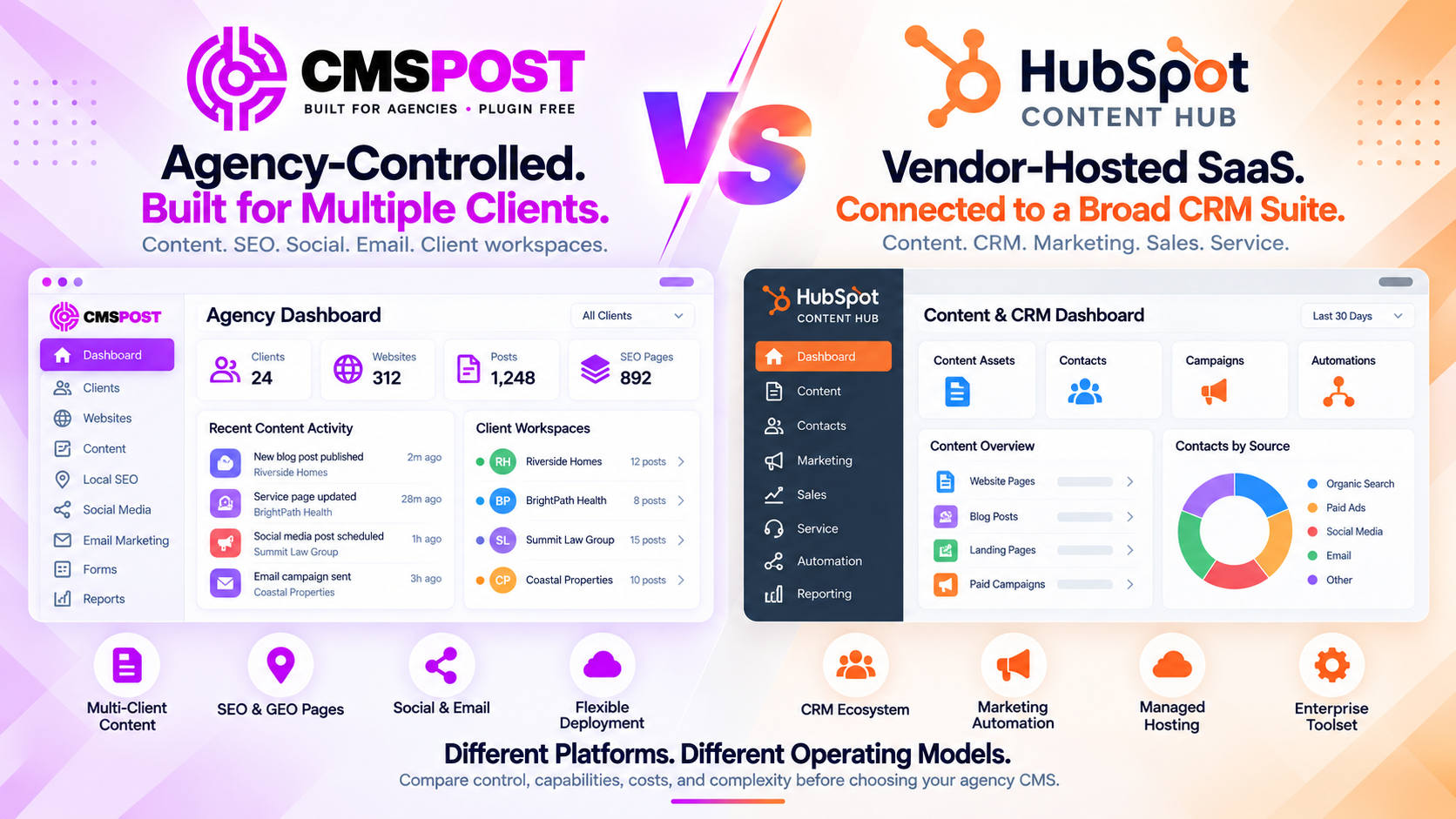
CMSPost and HubSpot Content Hub both connect content with broader marketing activity, but they approach that goal from different business models. HubSpot provides a vendor-hosted content system inside a large customer platform. CMSPost provides a lightweight, agency-controlled environment for managing content and distribution across separate client businesses. The right choice depends on whether the operation is organized around one company's customer platform or an agency's portfolio of independent clients.
Platform Classification at a Glance
HubSpot Content Hub—previously known as CMS Hub and still widely searched as HubSpot CMS—is best classified as a vendor-hosted content marketing and CMS SaaS platform. CMSPost is best classified as a lightweight, plugin-free, agency-controlled, multi-client content and digital marketing platform.
Classification
HubSpot Content Hub
CMSPost
Hosting
Vendor-hosted SaaS
Agency-controlled installation on compatible hosting
Primary purpose
Content connected to HubSpot's customer platform and CRM
Content and marketing operations across isolated agency clients
Expansion model
Hub subscriptions, seats, credits, marketplace apps, and integrations
Connected native agency engines without a traditional plugin stack
Website model
Sites and content built within HubSpot's hosted environment
Multiple delivery options for compatible existing websites
Best fit
Organizations invested in HubSpot CRM and customer-platform workflows
Agencies managing many independent client businesses and domains
HubSpot Content Hub’s Central Advantage
HubSpot’s greatest advantage is integration with its customer platform. Content can support lead generation, calls to action, forms, CRM activity, marketing automation, sales, service, analytics, and customer-journey reporting. HubSpot’s official materials highlight blogging, landing pages, website management, SEO recommendations, personalization, content remixing, podcasts, video, reporting, and AI-assisted creation.
For a business already operating HubSpot CRM, this connection can be compelling. A visitor does not remain an anonymous page-view statistic once that person converts. Marketing and sales teams can connect content engagement with a contact record and subsequent activity. CMSPost does not currently attempt to replace the full depth of HubSpot’s CRM, enterprise automation, sales, or service products.
CMSPost Begins With the Agency Portfolio
CMSPost starts from a different organizational question: how can an agency produce and manage work for many unrelated clients without mixing their users, websites, social connections, email activity, forms, and publishing records? The platform separates each client business while giving the agency a consistent operating environment.
Blogs, website pages, and Service Area content are distinct engines rather than generic documents. Metadata and advanced structured data can remain attached to the content. An agency can turn a long-form article into platform-specific social material, coordinate email activity, collect inquiries, and preserve the connection between every asset and the correct client.
Vendor-Hosted SaaS Versus Agency-Controlled Deployment
HubSpot Content Hub is vendor hosted. HubSpot manages the core application, hosting environment, platform updates, availability, and security program. This removes a significant technical burden and is a legitimate advantage for organizations that prefer a managed system.
The tradeoff is platform dependence. The organization works within HubSpot’s account structure, feature tiers, seat model, credit system, templates, development framework, and supported export or migration paths. Connecting a custom domain does not make the underlying application self-hosted. The website and content operation remain dependent on HubSpot’s service.
CMSPost is installed within a compatible environment selected by the agency. Its rendered delivery, embedded delivery, Mirror Mode, static output, and Theme Engine are intended to support different client-site circumstances. An agency may preserve an established website instead of migrating the entire property into a vendor CMS. That control also means the agency must take hosting, monitoring, backups, updates, and server security seriously.
Is HubSpot Content Hub Heavyweight?
HubSpot is not heavyweight in the WordPress plugin-stack sense. Customers do not install and maintain the core platform on their own servers. It is better described as feature-dense enterprise SaaS. The surrounding HubSpot environment can include Content Hub, Marketing Hub, Sales Hub, Service Hub, Data Hub, Revenue Hub, Smart CRM, AI agents, marketplace applications, seats, permissions, contacts, workflows, and usage credits.
That breadth can eliminate disconnected tools, but it also creates configuration, governance, training, and cost decisions. Teams must understand which subscription controls each feature, which users require paid seats, what consumes credits, how contacts and permissions are governed, and how multiple brands or websites fit within the purchased tier. One login can still contain a complex operating system.
CMSPost is narrower and lighter by design. It does not promise HubSpot’s entire customer-platform scope. It concentrates on repeatable agency content and digital-marketing delivery, reducing the number of systems an agency must coordinate for the workflows CMSPost handles natively.
SEO and Geographic Content
HubSpot provides credible SEO capabilities, including in-editor recommendations, page and blog tools, content strategy support, analytics, and an emerging answer-engine-optimization offering. It is especially useful when search content must connect with conversion reporting and CRM activity.
CMSPost’s differentiation is agency-managed local and geographic production. Its Service Area Engine helps organize content across cities, regions, services, and client domains. Agencies can create substantial location pages with metadata, schema, calls to action, and controlled delivery instead of treating each page as an isolated campaign asset.
Neither platform guarantees rankings. Search performance depends on useful content, technical accessibility, website quality, authority, competition, internal linking, page experience, and responsible strategy. The distinction is workflow: HubSpot connects SEO with a customer platform, while CMSPost organizes SEO content across an agency portfolio.
Pricing, Seats, Credits, and Total Cost
HubSpot’s current Content Hub pricing includes Free, Starter, Professional, and Enterprise editions. At the time of this comparison, HubSpot lists a free edition for up to two users, promotional Starter pricing beginning per seat, Professional beginning around $450 per month with three Core Seats, and Enterprise beginning at $1,500 per month with five Core Seats. Published pricing can vary by billing term, promotion, currency, configuration, and additional products.
Professional and Enterprise features are where organizations gain more advanced content operations. Enterprise is positioned for capabilities such as multiple sites and content approvals. Additional Core Seats and HubSpot Credits can increase total cost, and an organization may also license other Hubs, services, marketplace applications, or onboarding. The correct calculation is not simply the entry price of Content Hub; it is the complete HubSpot configuration required by the team.
CMSPost plans scale around the number of managed client domains and include unlimited seats in the agency proposition. Its cost should still be evaluated with hosting, communication volume, outside providers, implementation, and agency labor. For agencies, a useful metric is total platform cost divided by the number of revenue-producing client accounts.
Security and Administrative Responsibility
HubSpot’s managed infrastructure gives it an important security advantage over software assembled and maintained separately by each customer. HubSpot publishes a formal security program covering organizational controls, product security, infrastructure, data protection, incident management, and compliance resources.
Managed security does not eliminate customer responsibility. Organizations still control users, roles, domains, integrations, connected applications, data exports, consent practices, API credentials, and account offboarding. Marketplace integrations can introduce additional vendors and data relationships that require review.
CMSPost reduces dependency on a traditional plugin stack but remains software that must be secured. Agencies are responsible for compatible hosting, access controls, two-step verification policies, backups, updates, monitoring, and incident response. HubSpot offers more vendor-managed infrastructure; CMSPost offers more agency-controlled deployment.
Which Platform Should You Choose?
Choose HubSpot Content Hub when the organization wants content deeply connected to HubSpot CRM, lead generation, enterprise automation, sales, service, personalization, and customer analytics—and accepts a vendor-hosted subscription ecosystem.
Choose CMSPost when an agency needs to manage many independent client businesses, publish long-form and geographic content into compatible existing websites, coordinate social and email workflows, avoid a traditional plugin stack, and retain greater control over deployment.
Some agencies may use both. CMSPost can organize agency content production and distributed publishing while HubSpot manages CRM and lifecycle automation for selected clients. The strongest decision follows the operating model: HubSpot is centered on one customer platform; CMSPost is centered on the agency’s multi-client delivery system.
Frequently Asked Questions
Is CMSPost a complete replacement for HubSpot Content Hub?
Not for every organization. HubSpot Content Hub is deeply connected to HubSpot CRM and its broader customer platform. CMSPost is more specialized around agency-controlled, multi-client content, local visibility, publishing, and deployment.
Is HubSpot CMS self-hosted?
No. HubSpot Content Hub is a vendor-hosted SaaS platform. HubSpot operates the underlying CMS infrastructure, security program, and product environment.
Which platform is better for managing content across many agency clients?
CMSPost is purpose-built around isolated client businesses and domain-based agency plans. HubSpot can support multiple brands and sites at higher tiers, but it is structured around HubSpot accounts, subscriptions, seats, and customer-platform operations.
Which platform is stronger for CRM-connected marketing?
HubSpot is generally stronger when content must connect deeply with CRM records, lead scoring, sales, service, and enterprise marketing automation.
Can CMSPost work with an existing website?
Yes, in compatible environments. CMSPost supports several publishing and deployment approaches intended to preserve existing client websites while centralizing agency content operations.